| Hell Sucks |
A Writer Remembered |
| Michael Herr , Writing On Vietnam- 2 , July 3, 2016 |
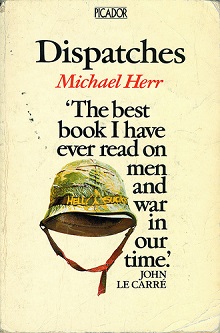 The war in Vietnam generated a new vocabulary. Fragging, attacks on officers, became regular. Over the years 1969-1971 Congressional data recorded 730 incidents and death at the hands of their men of 83 officers. But the centre of the language remained one of euphemism. The word “war” was officially avoided in preference for “conflict” or “involvement” or even “experience”. Herr filled “Despatches” with a new lexicon.
 The adjective most used for Herr's book was “hallucinogenic.” Its meaning is hazy when applied to prose but the reviewers were responding to the mix: long unfurling sentences, many unfamiliar words, fact of the author's own heavy use of drugs. Herr was never the journalist needing a story to file for the next deadline. He was engaged. “I went to cover the war and the war covered me; an old story, unless of course you've never heard it." Most of all he was engaged with the men, who were his juniors in age. “I just can't hack it back in the World.” The speaker was a 4th Division Lurp, a term in a book that was published without glossary. This veteran was on his third tour. On the first he had been the only survivor of a platoon wiped out in the Ia Drang Valley. In 1966 he was in an ambush and hid under corpses while Vietcong with knives stripped them of gear and berets. When Herr met him he went out on jungle patrol with the left pocket of his tiger suit filled with downers and the right pocket with uppers. He took them by the fistful. Back in the US the veteran would sit in a room all day. “Sometimes he'd stick a hunting rifle out the window”, Herr writes, “leading people and cars as they passed his house until the only feeling he was aware of was all up in the tip of that one finger.” Herr was a perennial close watcher. He committed to paper the faces that Don McCullin caught on film. He is with a marine who had been tired and scared for six months. “He had one of those faces, I saw that face at least a thousand times at a hundred bases and camps, all the youth sucked out of the eyes, the colour drawn from the skin, cold white lips, you knew he wouldn't wait for any of it to come back. Life had made him old, he'd live it out old.” Death was ubiquitous, as much from self as from the enemy. The suicides among the veterans of Vietnam exceeded the deaths in the combat zone by a quarter. But as much as death was the terror of emasculation. “On the “wound of wounds, the Wound. Guys would pray and pray- Just you and me, God. Right? - offer anything, if they could be spared that: Take my legs, take my hands, take my eyes, take my fucking life, You Bastard, but please, please, please, don't take those.” Writing that hits does it in detail. Herr comes across the kid who is obsessive in reading the long lists of casualties in the newspaper “Stars and Stripes”. He is searching for anyone else from his home town in Montana. His searching has a logical illogic to it. “I mean, can you see two guys from a ragged-ass town like Miles City getting killed in Vietnam?” In Khe Sanh a Marine is killed by a grenade attached to a latrine door. “The Command try to blame it on a North Vietnamese infiltrator, but the grunts know what has happened: “Like a gook is really gonna tunnel all the way in here to booby-trap a shithouse, right? Some guy flipped out is all.” Herr raises his eye at times from the close-up view to the strategy of the war, except that there was none beyond attrition. 110,000 tons of bombs fell during eleven weeks of the siege of Khe Sanh. The targeting was rough as was so much of the rural devastation. “We never announced a scorched-earth policy; we never announced any policy at all, apart from finding and destroying the enemy.” The writing of “Despatches” was when the last helicopter had been ditched in the sea twenty miles off Saigon. The book is hung over with an inexorable quality of hopelessness. “Maybe it was already over for us in Indochina when Alden Pyle 's body washed up under the bridge at Dakao, his lungs all full of mud; maybe it all caved in with Dien Bien Phu.” The power of the book is that it is not neutral. “You cannot be detached,”, he wrote, “If you are, you don’t get it, however much you want to be a pure observer. If you are neutral, you don’t understand it.” He was dependent for his life on the young grunts. “They”, he said, “are my guns”. He saw the hierarchy starkly. “At the bottom was the shit-faced grunt, at the top of a Command trinity: a blue-eyed, hero-faced general, a geriatrics-emergency ambassador and a hale, heartless CIA performer”. The spooks of the CIA are fantasists. He says of one “if William Blake had ‘reported’ to him that he’d seen angels in the trees.. he would have tried to talk him out of it. Failing there, he’d have ordered defoliation”. Herr's time in the capital was a haze of drugs to a Hendrix soundtrack. “Sitting in Saigon was like sitting inside the folded petals of a poisonous flower, the poison history, fucked in its root no matter how far back you wanted to run your trace.” The protection was always temporary. “You could be in the most protected space in Vietnam and still know that your safety was provisional, that early death, blindness, loss of legs, arms or balls, major and lasting disfigurement - the whole rotten deal- could come in on the freaky-fluky as easily as in the so-called expected ways. You heard so many of these stories it was a wonder anyone was left alive to die in firefights and mortar-rocket attacks.” The country, or the half-country that the US holds, is lived in by another people. They make their appearance as occasional strangers. On the book's opening page Herr is looking at a faded map of old Vietnam divided into its former territories. Reading a map of the country was like “trying to read the faces of the Vietnamese...that was like trying to read the wind.” Later twenty-five journalists and a television cluster round a wounded soldier of the army of the South. He is a teenager shot three times in the chest and he tries to smile. “The Vietnamese did that when they were embarrassed by the nearness of strangers.” On a mission he sees a fat Marine being photographed in the act of urinating into the open jaws of a North Vietnamese soldier in decomposition. The grunts all have their photo albums with the same photos: “the severed head shot...a lot of heads, arranged in a row, with a burning cigarette in each of their mouths...the VC suspect being dragged over the dust by a half-track or being hung by his heels in some jungle clearing.” A line of ears on a piece of string are called by their owner his “love beads.” A soldier says that corpses also provide “the number-one souvenirs”, “leaving the details to our imaginations.” Herr is scathing on the upper echelons in the media. Vice-presidents and foreign editors would fly in for three days of briefings and helicopter rides. “They'd go home convinced the war was over, that their men on the ground were damned good men but a little too close to the story.” The best of books are worlds of their own. Herr's Vietnam is a world with “a fat roach that sat on my Zippo in a yellow disc of grass tar. There were mornings when I’d do it before my feet even hit the floor. Dear Mom, stoned again. In the Highlands, where the Montagnards would trade you a pound of legendary grass for a carton of Salems, I got stoned with some infantry from the 4th.” He remembers entering Hue in semi-ruin after a huge assault. In the city park he comes across four corpses turned green. Nearby a tall decorative cage holds a small shivering monkey. When he returns the corpses have gone and so too has the monkey. It has made a small meal for one of the countless refugees who flood the city. Michael Herr 13th April 1940- 23rd June 2016 |
Reviewed by: Adam Somerset |
This review has been read 576 times There are 19 other reviews of productions with this title in our database:
|
