| The Science of How The Arts Transform Our Health |
Art & the Senses: Body & Mind |
| Daisy Fancourt- Art Cure , Cornerstone Press , February 16, 2026 |
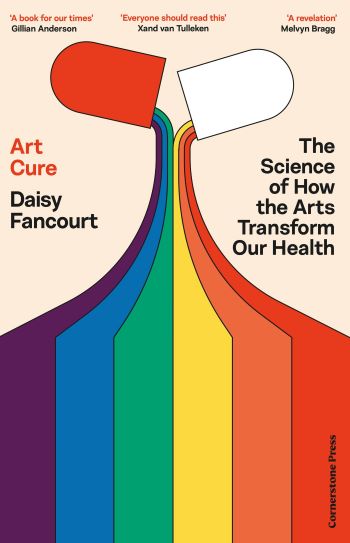 The literature on neuro-aesthetics is extensive. It is introduced in the link below 30th January 2025.
Music is its most studied form with the visual arts following. Theatre features little; a reason is practical. Fitting audience members with electrodes on their heads is not easy in a theatre. One theatre director only receives a mention in “Art Cure”; he is Augusto Boal and his “Theatre of the Oppressed” in Rio de Janeiro. * * * * Daisy Fancourt has a background to impress. She is Professor of Psychobiology and Epidemiology at University College London where she heads the Social and Biobehavioural Research Group. She is Director of the World Health Organisation Collaborating Centre for Arts and Health with 300 scientific papers to her name. She is a World Economic Forum Generation Global Shaper and BBC New Generation Thinker. She was the first to take neuro-aesthetics from theory to an empirical setting. In 2015 she and composer Eric Whitacre conducted the first experiment outside a laboratory to measure the biological effect of attending a concert. Saliva swabs taken before and after a concert showed a notable decrease in stress hormones. (The experiment is cited in the link below 7 April 2021.) Daisy Fancourt was cited by Melvyn, Lord, Bragg in the House of Lords when he moved a debate on 1st February 2024 entitled “That this House takes note of the contribution of the arts to the economy and to society.” “If ever utterly conclusive proof were required of the benefits of the arts in our society” said Bragg. “Here it is—she has nailed it. She says: “In 2018, the World Health Organization reported that after 3,500 studies, it had cast-iron evidence of the deep and widespread health improvements which came from the teaching of the arts, from neurological disorders to child development. “Cohort studies have shown that tens of thousands of people of all ages benefit physically, emotionally, and intellectually by going to galleries, by dance and singing in choirs”.* * * * * “Art Cure” contains two illustrations. The first has the heading “Regions of the brain activated by music.” Eight brain areas are identified. In the lower brain the nucleus accumbens and amygdala govern the emotional response. The hippocampus responds to pattern recognition and anticipation. The stem and cerebellum process sounds and beat anticipation. Broca's and Wernicke's areas do lyric recall and repetition. Five areas in the cortex are put to work. The visual cortex does score analysis. The auditory cortex analyses volume, chords, melody. The somatorysensory cortex is engaged with tactile feedback and the motor cortex responds with movement. The pre-frontal cortex is the locus of personal memories. Aesthetic experience is a rich creator of sensation in memory. “Art Cure” goes back to the beginnings. “We are a planet of 8 billion artists.” The lineage is long. “Tangible evidence of our artistic prowess can be traced back 40,000 years.” The manifestation was across the forms of art: figurines, bone flutes, drums from animal skins, cave paintings, patterning of foot-marks. The cause was a three-fold cognitive changing. The brain evolved the capability to conceive a mental image. There was the intention to communicate via a formal making. And, significantly, humans became the species driven by the attribution of meaning. * * * * Science quantifies. “On average, we read 700 books in a lifetime, watch 5000 films and listen to 1.3 million songs. The global cultural sector provides nearly 30 million jobs worldwide and has an estimated worth of $4.3 trillion dollars. [9 zeros]. As a species we are obsessed.” “Art Cure” covers both detail and an important general analysis. The cardio-vascular and respiratory systems relax after an aesthetic encounter. The vagus nerve sends signals of these effects all over the body. Reception by the adrenal glands lower adrenaline levels. Facial nerves relax tension in the corrugator supercilii and orbicularis oculi muscles. Signals via the pelvic nerve improve gastro-intestinal rhythm. At a higher level “Art Cure” makes a distinction between the sensory system and its correlate, the perceptual system. The former conveys a richness of raw real-world data. The latter converts this richness of input data into concepts. The effecting forces on this process are various: emotions, memories, expectations, prior knowledge and workings fuse and interact. Thus “this intersection between what we sense and what we perceive is arguably where the “magic” of the arts occurs- the moderation of our sensory system in action.” * * * * As creatures bound in time and space the physiology of time is of high importance. Systemic rhythm, beats in time, can be felt if attention is turned away from the torrent of data from the world. Oscillations in the heart, waveforms in blood pressure, breathing and electrical brain activity all operate at a pace that is relative. Compared with avians human physiology is quite sluggish. But then we are gazelles compared to an alligator with its heart rate of 10 to 20 beats per minute. The book records that time and artistic appreciation were tested experimentally by researchers on visitors to two locations of overwhelming artistic experience. An early study at the Metropolitan Museum of New York in 2001 observed that the average time spent with an individual art-work was 27.9 seconds. A study in 2016 at the Art Institute of Chicago came to the same close result of 28.6 seconds. The nature of the encounter changed greatly in the interval between the two studies. 35% of the viewers in Chicago used up perceptual time in self-photographing. The disjunction between the nanosecond pace of the non-actual world and the slow nature of our own material substance is profound. The consequences, and misunderstandings, can also be profound. [To be concluded in part two.] *The debate in the House of Lords is subject of an article on this site 10 October 2024 in the sequence “Culture in Westminster.” |
Reviewed by: Adam Somerset |
This review has been read 540 times There are 16 other reviews of productions with this title in our database:
|
