| “Health isn't something that just happens to us. It's performative.” |
Art & the Senses: Body & Mind |
| Daisy Fancourt- Art Cure- The Science of How The Arts Transform Our Health , Cornerstone Press , February 23, 2026 |
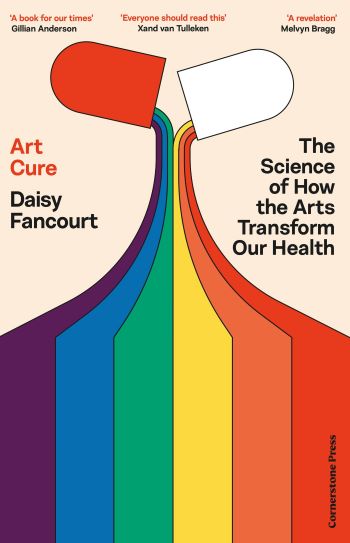 The conclusions in Daisy Fancourt's book, along with other studies, has been a cause of great interest to policy-makers and commentators.
 The Arts Council of Wales commissioned its own study and published it 19th January with a headline “How the arts power a healthier Wales: £588 Million Annual Impact on Health and Productivity.” The Stage in its new magazine format had an article by Lyn Gardner in its February issue under the heading “The Long Read.” The heading read “Operating theatre: how the arts are transforming health care.” The text beneath used a more sober verb that “theatre is revitalising health care.” Lyn Gardner alighted on Hull Truck, a Bognor Regis company, English National Opera, Theatre Space in Sunderland, Alder Hey Hospital and Theatr Clwyd. Theatr Clwyd has been in collaboration with its health board for more than ten years. It has a seat on the local NHS arts and health steering board. It has a long-running programme Arts from the Armchair for dementia sufferers and Dance for Parkinson's. Hester Evans, creative engagement associate, is cited: “Arts and health are not for every artist but many are good at it. Creativity is all about failure...it's how you develop...When you do this work, you start to make different choices as an artist about what is important to you.” * * * * “Art Cure” is not a book about aesthetics but it nudges into some aspects. In the case of visual arts a first impression takes 0.3 seconds and a deeper appreciation 0.6 seconds. This fits with Marr's Theory of perception. But an emotional response takes 3-4 seconds. And appreciation, for it be meaningful takes minutes, not seconds. These facts of human physiology and cognition are not congruent with culture in its newest and dominant form, the algorithmically curated short form. * * * * Daisy Fancourt writes of art's necessary content of tension. “The higher the discomfort in the tension phase, the higher the pleasure when we finally get our pleasure. We can feel this clearly in “drops” in dance music or in twists and turns in detective novels when we keep thinking we've solved the murder only to discover a new fact that throws everything up in the air again.” The combining of expectation and pleasure was a result found by Mikhail Czikszentmihalyi. Paul Dolan has attached electrocardiographs to four hundred audience members attending a Fatboy Slim event. The research found a congruence of heart-rate in anticipation of the drop. Tension-resolution is identified by “Art Cure” as a centre, if not the centre, of the aesthetic experience. Interestingly it does not diminish with repetition. Returning to the example of a detective mystery “We simply change our focus the second or subsequent times. Even when Detective Poirot has revealed the murderer...there is huge satisfaction (and pleasure) in rereading the mystery to look for subtle clues we might have missed the first time round.” This is of course what makes it art. Charles Jencks, an analyst of high importance, includes formal complexity as critical. * * * * “Art Cure” is of limited use to Arts Councils in their practical decision-making. For one Daisy Fancourt's language is direct and relates to the reality of human seeking of artistic experience. To use a word like “pleasure” is not permitted in policy-making circles. In England Lisa Nandy can cite Jennie Lee to the effect “the greatest art comes from the torment of the human spirit.” This kind of language is beyond that used in policy-making circles. Daisy Fancourt also casts her definition broadly. The arts involve “imagination, creativity, novelty, emotional expression...beauty.” These factors distinguish painting, dancing, singing, acting, writing. But she extends the exemplars to baking and decorating cakes, growing arrangements of flowers in an allotment or performing choreographed ice-skating. Lastly, she steers away from a binary opposition of health verus ill-health. The body is a homeostatic entity moving through time and space. “Health isn't something that just happens to us. It's performative.” A ringing paragraph declares: “Art can have dramatic influences on our health. If children engage in art workshops, choirs, book clubs, dance classes, drama groups or bands they are less likely to be lonely or develop behavioural problems. “Arts build vital life skills, from self-control to self-esteem, empathy and motivation. They keep us socially connected and less sedentary, all of which add up to affect our future health. Art props us up not only to survive, but to thrive and flourish. “...You'll say that I'm being sensationalist. And this book isn't about sensationalism. It's about science.” * * * * References: The Arts Council of Wales' report on the subject can be read at: https://arts.wales/news-jobs-opportunities/how-arts-power-healthier-wales-ps588-million-annual-impact-on-health Marr's Theory: David Courtenay Marr, 1945-1980, cognitive scientist, neurobiologist, and physiologist Paul Dolan: Professor of Behavioural Science in the Department in Psychological and Behavioural Science at the London School of Economics and Political Science. Research with Fatboy Slim private conversation 17th February 2026 Charles Jencks wrote extensively on the elements of an art-work in Prospect Magazine August 2001. Mikhail Czikszentmihalyi,1934-2021, was the Distinguished Professor of Psychology and Management at Claremont Graduate University and formerly head of the department of psychology at the University of Chicago. His “Flow: The Psychology of Happiness Optimal Experience” or “Psychology of Happiness” was given to all the members of the Cabinet in the 1990s for their summer reading. Lisa Nandy gave a lecture on 20th February 2025 to mark the the 60th anniversary of the first ever white paper on the arts. Rose Horowich wrote about students in the USA who had signed up for courses on film. Many were reluctant to sit with other students watching films. When asked to nominate films for discussion many had not seen a film. Their visual experience was on smartphones; on average the time-span for which a piece of content received attention was 47 seconds. Source: the Atlantic https://www.theatlantic.com/ideas/2026/01/college-students-movies-attention-span/685812/ |
Reviewed by: Adam Somerset |
This review has been read 218 times There are 16 other reviews of productions with this title in our database:
|
