| "Time to Think...and with that Time to Feel" |
Art & the Senses: Body & Mind |
| How Reading Made Us , BBC Radio 4 , March 16, 2026 |
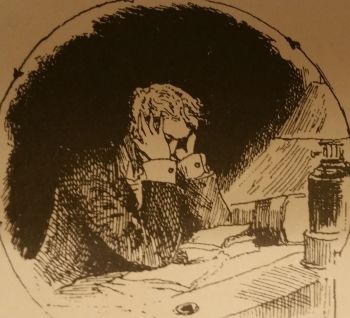 This sequence, in a year of summary, looks at the aesthetic, psychological and physiological factors that pertain to performance in particular and the arts in general.
 A widely publicised article in January reported on film students. Rose Horowitch wrote for the Atlantic “The Film Students Who Can't Watch Films”. She had previously written “The Elite Students Who Can't Read Books.” One reason for the reluctance to watch films was that they were no longer located in a particular point in time or in a specific place. Everything is reproducible at any time, as was not the case in the era of cinema and broadcast television. A radio series “How Reading Made Us” from James Marriott followed up on this subject. A theme in the first episode, 9th March, looked at the importance of the book. Marriott started with the psychology of attention. He had read all his life but in 2010 he had ceased to read with attention. He got rid of his smartphone. “It made me annoying as a colleague and a friend but I can read again.” The phenomenon of low attention across time is well reported for its effects on education. “Professors said they had had to drop books they had been teaching all their careers because their students could not read them any more. "Big Victorian novels like “Middlemarch” were dropping off syllabuses. This meant that books that had been passed down for decades or centuries were just not reaching the next generation of readers.” * * * * The ambition of the programme is stated. “How reading alters our brains, how it changes the kind of emotions we experience, and how it created revolutions, wars and even democracy.” * * * * From Maryanne Wolf a prominent cognitive neuroscientist at University of California: “It took two thousand years to move from hieroglyphs in Sumerian to an alphabet. Our children are given two thousand days to come up with the same basic epiphany that moved from symbol to alphabet...The epiphany between what is seen and what is known as a word and a concept. “The first basic is when you have put four of those areas together: motor, vision, language and cognition.. There is time to think about what you are reading and with that there is time to feel. “The connection between the book, the human voice, the child and the growing system for understanding language, for making a connection between a book and language and always with the effect, if you will, of affection. “You are embedding the affection...By the time they reach your brain what you have is an extraordinary panoply of network connections...It is one of the most beautiful sights of activation....You are a walking activation map when you reach these deeper stages of reading. “Over time as reading changes we change with it. Human development changes with reading. Reading changes thought. Thought is changed by writing. Writing is changed by reading. The more we read the more that circuit develops, the more complicated and sophisticated our thoughts and our feelings grow over time. “That is what Proust said was at the heart of reading. We go beyond the wisdom of the author to discover our own. At the heart of reading is this centre, this place of interiority in which we think our own best thoughts.” Marriott: “Reading is itself a creative act. To lose reading is to lose a whole way of thinking.” * * * * Naomi Alderman: “The generation now who are being raised on smartphones ...being encouraged to interact with these technologies as early as possible will never forgive us for what we are doing to them. “...For children and young people the key thing is to develop those early skills of literacy, to be introduced to the ways in which you can use your mind in conjunction with text. This is what enables you to have a mind that has value in the world and will continue to have value whatever the AI will do, whatever the influencers are saying. To be able to use your brain well is the greatest gift that you will ever have. “...There were three intersecting innovations in ancient Greece that all relied on each other and they were all possible because of the invention of writing. The first is democracy, the second is the invention of the theatre, drama, and the third is jury trials. In ancient Greece a jury was at least two hundred people. Much more like a theatre audience. And all of these rely on writing. “If you look at it is often about debating ideas, and to do that they have to be written... Set arguments against each other. Once you have that you able to have these three institutions which are fundamental to how we live today.” * * * * Joseph Henrich, author of the article “Martin Luther Rewired your Brain”: “When children learn to read, especially before the age of eight, it changes their brain. It includes a thickening of the corpus callosum. So, people who get literate get brain activation, when they hear spoken sounds...this has been caused by reading.” * * * * Maryanne Wolf on reading via a smartphone: “This is two different forms of reading with two different possibilities...I use the skim mode which is best used on a screen...the “F” pattern or the “Z” pattern....It is not that we cannot read deeply on a screen but it takes much more effort. Print is the far better medium for the deeper, more serious and. if you will, beautifying. “If you look at the data there were 170,000 subjects in a meta-analysis, reading the same thing in print and on screen and then having comprehension questions afterwards. The largest group of the young adults who were studied had a personal preference for the screen but were unaware that they were better at answering the comprehension questions on print. For comprehension of plot, detail, sequence the print was much the better. “This goes back to the deep reading brain circuit in which attention, either gives focus to all these inferential, analogical, empathic, critical-analytic processes or just gives a surface read. Deep reading with print is more likely to slow down that process and give more time. The brain can can linger more with print.” Excerpts, with thanks and acknowledgement, to be heard in full at: https://www.bbc.co.uk/sounds/play/m002sdyn |
Reviewed by: Adam Somerset |
This review has been read 88 times There are 7 other reviews of productions with this title in our database:
|
