| Wide-ranging, Lucid Guide to the Psychology of Experiencing Art |
Art & the Senses: Body & Mind |
| Ellen Winner-How Art Works , Oxford University Press , May 4, 2026 |
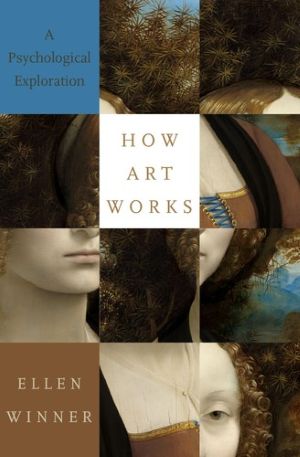 The subtitle of “How Art Works” is “a Psychological Explanation.” Its 245 pages are augmented with 59 pages of notes, bibliography and index.
 Ellen Winner is Professor Emerita of Psychology at Boston College and Senior Research Associate at Project Zero, Harvard Graduate School of Education. She is a previous author of 200 articles and 4 books. She is a recipient of the Rudolf Arnheim Award for Outstanding Research by a Senior Scholar in Psychology and the Arts. She is a Fellow of the International Association of Empirical Aesthetics. “How Art Works” combines a historical and theoretical overview with examples of empirical, experimental work. From the past she starts, as do all, with Plato then jumps to the Enlightenment. “Kant defined art as a kind of representation that has no external purpose, that exists only for itself, though it has the power to communicate and stimulate our minds.” “Tolstoy defined art in terms of its function to express emotion.” “Clive Bell defined art as something that has “significant form”- non-representational combinations of lines, colours, shapes, that lead to aesthetic emotion- because only significant form can provoke an aesthetic emotion, an emotion different from all other kinds of human emotions, one that transports us out of ordinary human concerns into an exalted state.” “Monroe Beardsley offered a functional definition; a work of art is something that affords, or is intended to afford, an aesthetic experience- that is, causes us to consider the aesthetic value of an object.” * * * * The chapter “In Sum: the Healing Work of Art” looks at empirical aspects of artistic activity. Developmental psychologist Eleanor Brown worked with disadvantaged children at a Head Start pre-school who had a daily 45-minute arts enrichment session. It spanned music, dance and visual art. Saliva tests before and after showed a lowering of cortisol levels. Among adults facing medical procedures- a cause for raised stress- reduced levels of anxiety were observed in those who played the piano, modelled clay figurines or did calligraphy. Taking part in drama had a result in enhanced control over personal emotions. “Pretend” emotions were transferred to use in non-pretend situations. “Goldstein and Lerner cite much evidence that gaining control over one's personal distress is associated with the ability to respond more appropriately to another person's needs.” A study looked at electrical activity in the brain. “Making an oil pastel painting for 20 minutes increased electrical activity in the brain consistent with lower cortical arousal, relaxation and self-regulation.” Jennifer Drake, a former doctoral student of Ellen Winner, did repeated studies of children and drawing. “The simple act of drawing improves mood in children.” Interestingly the greater the directing of drawing to fictional elaboration the greater was the result in mood enhancement. The second part looks at the book's treatment of wider psychological and aesthetic issues. |
Reviewed by: Adam Somerset |
This review has been read 217 times There are 16 other reviews of productions with this title in our database:
|
