| In the Bran Tub of Memory |
Visual Arts |
| Clive Hicks-Jenkins at Symposium on Landscape and Memory , Museum of Modern Art Machynlleth , April 14, 2016 |
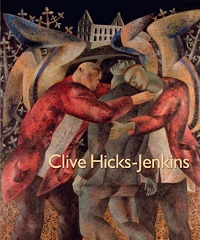 The painter Clive Hicks-Jenkins is present in Machynlleth for a day of presentations and discussions linked to the exhibition.
 Writers and artists often appear on public platform. Some are there perforce as a condition of receipt of an award or grant. Some are there at the behest of publisher or agent. Some have a natural talent, as did Dickens or Wilde, for public address; some less so. Some have things of value to say that add to the work and for some not. Clive Hicks-Jenkins is of the former group. He communicates to his audience, in the tabernacle pews, clarity with warmth, sense without sentimentality, autobiography without grandstanding. His works show on the screen but he says that his words may not directly connect with a particular image of the moment. His talk is talk as a constructed entity rather than as a series of footnotes to screen images. His gift on a public platform may be due to his background. As with the photographer Angus McBean theatre courses through the life experience. As with McBean Hicks-Jenkins has also been early on a maker of masks. He goes straight to the point. He diverges from his fellow exhibitors in that he is without any formal art training. In its place he had an apprenticeship that was distinct, deep and relatively late. The first work was made both at and of Tretower in the valley of the Usk. His period of deep and solitary absorption came when he had reached the age of forty. If the overhang of John Piper and his contemporaries is potent in the first work it has a reason. The schoolboy had exposure to the British Neo-Romantics. Hicks-Jenkins recapitulates the personal biography that eventually made the art that is utterly his own. School in Newport, Gwent is a cause of personal misery. The aspiration to dance is diverted by parental guidance to education in acting. Barely a teenager he becomes a pupil at the Italia Conti school. Its location is billed as North Clapham but its actual location site is in Brixton. Home is lodging in a salubrious maisonette in Dulwich Village which is home of an uncle. The uncle, a sports journalist of some renown, is often absent on interview with the likes of the then Cassius Clay. The schoolboy is effectively frequently alone apart from the daily visit of a housekeeper who ensures the availability of an evening meal. At weekends the galleries of London beckon, largely because they come with the advantage of being free to enter. London is more than the great public collections. Then, as now, Cork Street and its environs in St James are where the dealers cluster. Then, as now, a bold visitor may enter freely. The gate-keepers might appear alarming but in fact prove to be welcoming to the interested schoolboy. The commercial galleries of this time are filled with Piper, Sutherland, Craxton, Minton and McBride. It is an education to the young eye. But a busy quarter of a century of life in the theatre as performer, director, choreographer and designer is to intervene. He has become a custodian at Tretower before first application of acrylic oil is made. He has had an early and particular education in landscape that is also particular. He has been told to revere the parks of London but dislikes their containedness and order. This goes back to the experience of Wales. Journeys with his father who was a way-leaver for the electricity board took him out and beyond Newport. A site above Merthyr was a prospect of burnt-out cars and telegraph wires thrumming in the wind. “My father saw beauty” he says “in dereliction and solitariness.” Hicks-Jenkins refers to the canon of painting lightly but like Hockney he comments with the authority of one who makes pictures. He can tell the difference between the image that is made via the unaided eye and that when an intervening device is present. In “the Marriage of the Arnolfini” the position of the light that hangs above the betrothed couple is located with a precision that goes beyond the unassisted hand of any artist. Van Eyck had recourse to some kind of optical aid but it does not diminish him. He is still a genius of painting. Hicks-Jenkins has less respect for the over-dominance of the painted or drawn image mediated by the camera. He can distinguish the painting that has been made via a photograph from the one which has not. On the imagination inherent in his own art he comments interestingly on the presence of a model before him. “If the model is in front of me I get distracted.” As for the rendering of landscape he says “en plein air I am trying hard to get a likeness rather than getting to the heart of things.”If his art has one aesthetic grounding it is in his line “I paint from the inside.” That ground of subjectivity does not betoken an art of solipsism. His route from outer world to arrangement on flat canvas is in fact lengthier than the transmission of direct subject to canvas. Hicks-Jenkins prefers the period of the Renaissance before the application of perspectival finesse epitomised by Piero di Franscesco. His own paintings play with perspective but in a way that works visually. His transcription from reality from image has method and process. “St George and the Dragon” has an identifiable Weobley Castle in the background. It is an aerial view that is unobtainable. Hicks-Jenkins has made it via the mid-way form of a three-dimensional model. The artist in Machynlleth is simultaneously exhibitor, lender and speaker but he is also a viewer. On the subject of Minton, Vaughan and the others upstairs who have his admiration he says “what they were really good at was expressing emotion.” He is crisp on his own mission “Capturing ideas in your head and expressing them in paint is what matters.” Hicks-Jenkins' time on the Tabernacle stage has been wide-ranging, generously phrased and insightful. His world is one that is unmistakable. A skull-horse meets a human figure in pyjamas. Owls and geese frequent a congregation of birds. A wolf in a deep red snarls. The images over two decades are collated in a book from 2011 simply titled “Clive Hicks-Jenkins.” The nine essays that accompany the images add detail to the talk and amplify the means, motive and method to the art. The artist himself has a metaphor for memory. It is “a bran tub I plunge my hands into, churning my hands to see what I can find.” The book also reveals elements of mystery within the family. His mother presents him one day with a gold Torah on a chain with the explanation that he is Jewish. His sister is revealed to be a half-sister from another marriage and there is an unknown half-brother. The influences in young age are broad. A book on Egyptian sculpture goes hand in hand with Saturday cinema matinee. A friendship with an elder teenager introduces him to books on Michelangelo and Rodin. In a decaying Cardiff cinema he sees Jean Cocteau’s “La Belle et la Bete.”He calls theatre “a glittering, noisy carousel, a deceptive hall of mirrors, a queasy carnival of delights and horrors.” As for himself and the career in performance “the tragic paradox was that I was both perfectly suited for the life, and not. Later that confusion would catch me out and trip me up.” His first work at age fifteen is the Caricature Theatre, a repertory puppet company. He takes breaks for training in the tightrope and flying on wires. He moves to pantomime, choreography, and an offer to direct. “Plays and musicals followed, regional repertory work, touring seasons and West End shows, operas and cabarets, revues and Christmas television specials.” He is accustomed to sketching from childhood and one day a producer, shown some sketchbook ideas, asks “Why don’t you design our pantomime next year?” He admits that the decision to accept robs him of eight months’ decent sleep. The conception is vast, two hundred ornate costumes, a set too large to fit Cardiff’s New Theatre. But “Humpty Dumpty” works, even moves to London the next Christmas and “I began to feel like a designer.” The pall of theatre is compressed into a single paragraph, but it includes a perfidious producer, the hit to his personal standing, the life of constant travel and the swathe of AIDS cutting through friends and colleagues. The result is Tretower Court where he takes on at first a relief job for the custodian. He stays, sells tickets, answers enquiries, even puts on a uniform on the occasions of a visit by CADW management. The custodian’s hut freezes him in winter and stifles in summer. He sees later an analogy in art with the desert hermitages of early saints. “Tretower was where I landed when I threw myself from the parapets of a previous life.” But the visual images had been pouring in for half a lifetime. “Mildred Pierce” in his words “seared my retinas.” Marlene Dietrich in “the Scarlet Empress” captivated: “conjuring a hallucinatory world of insanity and candle-drenched voluptuousness.” Dance had been so constant in the life that Hicks-Jenkins sees small difference in the two genres. Of dance he says “after all, it’s very like drawing, except in dance the lines are drawn in the air, in three dimensions, and are invisible.” This world that is both logical and non-naturalistic is caught by writer Rex Harley who applauds “Hicks-Jenkins’ fascination with the beauty of ordinary things, and his ability to use them symbolically, as messengers of the transcendent and numinous.” That is for the critics to see. In person Hicks-Jenkins eschews the transcendent. “I am a narrative painter” he says “Discovering the things I love and to share them. That’s what painting is about.” As a summary that is as nice as it comes. |
Reviewed by: Adam Somerset |
This review has been read 122 times There are 27 other reviews of productions with this title in our database:
|
