| Ivor Roberts-Jones |
Visual Arts |
| Jonathan Black and Sarah Ayres- Abstraction and Reality , Philip Wilson Publishers , July 15, 2014 |
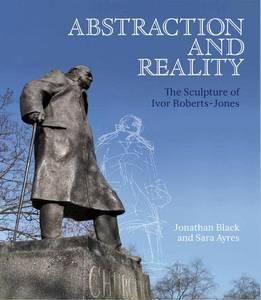 “Abstraction and Reality” is a title that might mislead. This study of the work and life of sculptor Ivor Roberts-Jones is light on speculation, abstraction or curatorial pirouetting. A fine tribute to Wales' foremost maker of public art in the twentieth century it comprises four essays by Jonathan Black and one by Sarah Ayres.
 The second half of the book is one hundred and forty pages of catalogue raisoné, notes, index and chronology. It is a heavyweight book, large in format, containing two thirty-five of the drawings and two hundred and twenty-eight photographs of the sculpture. Photographs for comparison feature works by Rodin, Gustav Vigeland, Walter Gropius, Elisabeth Frink and Charles Sargeant Jagger. The frequent documentary photographs include a full-page illustration of four Prime Ministers assembled in the Commons before a sculpture of one of their predecessors. Black swiftly deals with the autobiography. Ivor Roberts-Jones was born 2 November 1913 in Oswestry to a Welsh-speaking family originally from Aberystwyth. Drawing started at age three. Oswestry Grammar School was followed by Worksop College and then Goldsmith's College to study painting. Edward Bawden, a tutor, recognised great potential as a graphic artist but in 1934 Roberts-Jones determined that sculpture was to be his calling. The authors are illuminating on the aesthetics behind the work. In Rodin he saw the importance of drawing and memory as essential for grounding the making. [“Rodin's] sculptures frequently have a sense of perpetually arriving, of their own free will. Memory and immediate impulse appear to have become one thing.” Black relates the 1966 work “Seated Woman/ Mrs Griffiths” to a context that goes from classical Egypt and Greece to Frank Dobson and Henry Moore. The late small works in plaster and terracotta look to George Fullard and Eduardo Paolozzi. A sitter in the form of Sir Nicholas Goodison is cited sharply on technique in the making. “A head can best be discovered by covering it with a cloth and noting its extreme points and then working out the inter-relationship between them, rather than by worrying about the precise structure of the skin and bones between them.” Isabel Hitchman, arts officer at the Arts Council of Wales, is cited on the paradox of portraiture. Looking at the bust of Sir William Crawshay she notes “an amazingly good likeness but wasn't in any way photographic, or realistic in detail. Ivor had the most amazing ability to detect a persona beneath the skull and the sculpture would be unmistakably the subject- you would recognise him, or her, instantly but there was something more than that as well. Something about the character came through quite clearly.” The comment is the same as when friends commented on Kyffin Williams' treatment of xx Jonesxx. Roberts-Jones earned a description as “the last icon-maker”, the title Black gives to his fourth essay. Roberts-Jones sculpted statesmen and field-marshals, explorers, writers and artists of eminence. While notions of sculpture “diversified out of all recognition from the mid 1960s onwards”, writes Black, “Ivor became convinced the public was being left behind.” His statue of Churchill failed to receive mention in a catalogue of 1977 devoted to sculpture for the Silver Jubilee Celebrations. An essay even declared that “the artist has come more and more to rely on the critic to explain his work to the public.” Nonetheless Ivor-Roberts' work in stone, commemorative and celebratory, earned him an RA and CBE to his name and made him recipient of two medals from the Royal British Society of Sculptors. The making of the work was relentless in its preparation, sketches, clay maquettes made and remade, plaster casts sawn into two or three to make different forms. Sitters were not always easy. He was wary of the Speaker but “face-to-face with [George] Thomas Ivor found himself quickly falling under his spell.” Somerset Maugham is at a bad time of his life, convinced of family conspiracy against him and referring to his appearance as “an iguana sunning itself on the rocks.” However, a bit of “warming up” has the author talking freely and happily on himself and his opinions. The resulting work has a critic stating that the work has captured “both the magnificence and the pettiness of the man.” The life is full and not without incidence. War service in the jungles of Burma promoted the writing of verse for cathartic purpose. H commented little but said he had never been more frightened. Augustus John becomes cause of “one of Ivor's most important and torturous commissions.” Public art invites public rumpus and the noise in Fordingbridge was loud. Kyffin Williams was a friend for life and the book's first words are his. “Ivor Roberts-Jones was an immaculate, in fact pre-eminent draughtsman, a brilliant sculptor with an uncanny ability to interpret the character of his sitters” and, close to Williams' drawings, “a superb modeller of animals.” The relationship is close “It was always good to be with him as his opinions were so challenging and made me think.” With a touch of both realism and nostalgia he added “Maybe he was the last of his kind...sculpture is something else now.” Public art is not the province of dealers, aesthetes, or investors. To stand eye to eye with the seventy-five year old Sir Cennydd Traherne is to look into a face of knowledge, subtlety and complexity. |
Reviewed by: Adam Somerset |
This review has been read 624 times There are 27 other reviews of productions with this title in our database:
|
