| “Exultant Strangeness” |
Visual Arts |
| Landscape and Memory , Museum of Modern Art Machynlleth , April 13, 2016 |
 The location could not be more fitting for six hours of a Spring Saturday given over to a symposium on landscape and romanticism.
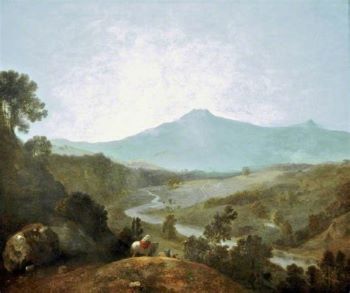
 Step out through the doors of Machynlleth's Museum of Modern Art, cross the road and the places and inspirations of Romanticism are right there in front of the eyes. Across the Dyfi and on to the high skyline; these are the places where travellers, writers, thronged. Richard Wilson was on Cadair Idris. John Ruskin called Wilson the earliest painter of ‘sincere landscape art, founded on a meditative love of Nature’. His view of the Mawddach Valley has as its real subject the great mass of Cadair Idris. The mountain is an object of beauty. His “Llyn Cau, Cader Idris” painted between 1765 and 1767 is now in the collection of the Tate. Its depiction of the upland wastes was ahead of the taste of his time and it stayed unsold in the artist's studio. Thomas Jones of Radnorshire too hardly impressed the connoisseurs. He was largely forgotten until the 1950s when his sketches emerged and showed a notable individualism. Watercolours of the hills a mile or so from his front door at Pencerrig, near Builth Wells, prefigure the pastoral utopias of Samuel Palmer thirty years later. A tradition formed; by the end of the eighteenth century Wales was a destination for peripatetic artists. The sublime was hardly to be felt or feared in the lowlands of England. The full scale of Creation and the depredation of time were manifest in mountain, waterfall, worked-out mine and ruined castle. John Sell Cotman was a witness at the young age of eighteen. For the seventeen year old Turner on his first visit the effect was transformative. Cotman was back in Wales two years later seeking artistic influence far from his home county of Norfolk. Long after his death Cotman became a modernist inspiration. His planes of colour breathe the values of the Neo-romantics. Two of that school's leading figures steeped themselves in Wales. Graham Sutherland described Pembrokeshire as “exultant strangeness”. John Piper was further north in the 1930s in Llanon, Aberaeron and Hafod. The period was his time of pivot between abstraction and the distinctive response to mountains and buildings. He too followed in the footsteps of Turner and others to Llanthony Abbey in its dramatic settings of the Black Mountains. Piper's depiction in 1941 of the massive towers under a lowering sky had a radical newness to it. Where Piper intuited a drama of light and climate David Jones, a denizen of Eric Gill’s community at nearby Capel-y-ffin, saw the landscape as a place of peace and safety. He had behind him the experience of the Battle of Mametz Wood. Ceri Richards, Swansea-born, spent long periods at Pennard on the Gower coast. His landscapes broke with precedent but won the praise of Henry Moore. “More than any other painter of his time” he said of Richards “he understood three-dimensional form and knew how to express it on a flat surface.” All these artists have been brought together for an exhibition on the Gallery's first floor. Cotman, and Turner are on display alongside Eric Ravilious, John Craxton and John Minton. Minton had found himself sent in 1943 to Barmouth for army training. He read “Welsh Sketch Book” by Graham Sutherland and he wrote of Barmouth. “The mountains are fine, mottled and serrated like Sutherland … swept by winds one can almost see roaring in whirlpools and eddies round the peaks and out to writhing grey sea.” His “Recollections of Wales” is a dense, unsettling master-work. An indefinable figure inhabits a setting of leafless trees, rock and hill. It is landscape as part-apocalypse and carrying a human presence that is light. Ivon Hitchens is on display and the refugee Expressionist Josef Herman, so captivated by the ‘sadness and grandeur’ of the Swansea valley that he made his home there for years. A generation of painters of recent decades round out the exhibition. The images of John Elwyn, Arthur Giardelli, Ernest Zobole, Josef Herman, David Tress, Glenys Cour, Bert Isaac and Glyn Morgan share space alongside conceptual artist Tim Davies and video artist Helen Sear. The course of Romanticism remains ever rich and ever evolving. The exhibition includes an acrylic painted on board called “The Barbarian Brought Down by a Lioness”. It is a savage piece of neo-romanticism in which creatures of nature are welded in contact against the coast of Amlwch. The cliffs and abandoned mines of the shore have been turned red in the shadow of nature's violence. All artists begin by working out their admirations. Clive Hicks-Jenkins' work swiftly acquired a distinctiveness that is entirely his own. The early works are small in size and have intimations of John Piper. “Black Sheep in a Welsh Quarry” from 1999 is rooted in a tradition. But soon the signature elements are taking shape. The buildings with their shadowy arches evoke de Chirico. A pottery Staffordshire dog has an eerie quality with its staring eyes. The subjects ring with mythic echoes. Man and wolf embrace. A man carries a bucket suspended by a noose around his neck. Angels reach out to humans. The terrifying Mari Lwyd horse figure, a key moment from the family history, is returned to again and again. The tower of Tretower is omnipresent in the background. A compressed composition is common, the perspectives worked out by the artist's making of models. Faith, folk art, a spirit of Chagall thread through the paintings. “A great writer creates his predecessors” said Borges and the same is true of painters. |
Reviewed by: Adam Somerset |
This review has been read 34 times There are 27 other reviews of productions with this title in our database:
|
