| India 1947 in Partition |
Places |
| Barney White-Spunner- Partition , Simon and Schuster , October 15, 2017 |
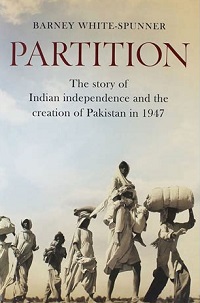 Anniversaries proliferate. There is a recent elasticity given to the interval of years themselves. Commemoration used to require a century, a half-century, a quarter-century but now every decade of time gone by is deemed significant. Seventy years, the threescore and ten, is not even the measure of a lifetime.
 Nonetheless, this August television programming was packed with commemoration of the closure of Britain in India. The documentaries were good, the debates less so, being too diffuse. Kehindre Andrews, a professor in sociology, contributed a version of the past that reduced it to a crude cause and effect of blame and shame. It was bad history, refuted by a rapid glance at Jan Morris for her view. The British, she wrote, had neither the concept nor a particular wish for a divided India. It was politics that did it and it was politics that the BBC coverage, for all its quality, was short on. Anniversaries too fade quickly. A book on the trauma of partition was published to coincide with August 15th, the date of freedom at midnight. “Partition:the Story of Independence and the Creation of Pakistan” by Barney White-Spunner received strong reviews as a good piece of accessible history. “Stands out for its judicious and unsparing look at events” was the verdict of Dominic Sandbrook for “the Times.” Before September had finished it was for sale in the Works with seventy-five percent of its cover price value of August lost. White-Spunner's history is clear-headed on the British. Neither Mountbatten nor Attlee and the Government knew anything about the vast country under their dominion. By the time of independence the politics of India had been incendiary for decades. Subhas Chandra Bose had raised a force of fifty thousand to fight in alliance with Japan against Britain. He was also instrumental in the forming of the Indian Volunteer Legion of the Waffen-SS also known as the Tiger Legion and the Azad Hind Fauj. Their involvement in the sub-continent was small. Some sabotage in Baluchistan was carried out and some officers were moved to the Indian National Army, Bose's main force. The Indians in Europe were deployed against the French Resistance and were active in Italy against British and Polish troops. Their capture and shipment back to India should have meant charges for treason. The soldiers' oath had been “I swear by God this holy oath that I will obey the leader of the German race and state, Adolf Hitler, as the commander of the German armed forces in the fight for India, whose leader is Subhas Chandra Bose”. But Britain was politically unable to carry out the trials. The authorities were fearful of revolt and uprising across the Empire. The BBC was ordered to make no mention of the subject. The Royal Indian Navy mutinied, to wide public support, followed up by smaller mutinies in the Royal Indian Air Force, and one in the Indian Army was put down with force. The events were crucial in determining the Labour government's policy. The Empire had lost the certainty that its armed forces would obey. The television documentaries that were broadcast in August in commemoration of India's independence omitted a crucial part of the country. It is the nature of the medium that it needs linearity and simplicity. The politics when they occurred were reduced to a three-way match of Jinnah-Nehru-Mountbatten. Vallabhbhai Patel did not feature. It was Patel, India's first Home Minister and Deputy Prime Minister, who brought the princely states under the sovereignty of the new government. The provinces were only part of the new government's dominion. The princely states, whose numbers ran into the many hundreds, were self-governing political entities. The documents of May and June 1946 proposed that the states be free to choose independence or accession to whomever they preferred. The Muslim League supported the proposal while the Congress rejected it. It was Patel who fought against Bengal and the Punjab being incorporated in total into Pakistan, a scheme rejected by Gandhi. It was Patel's relentless diplomacy, admittedly with the option in the background of using military force, that brought them into India. His will to create a national territorial unit was total. Gandhi told him “The problem of the States is so difficult that you alone can solve it”. Only Jammu and Kashmir, Junagadh and Hyderabad resisted his blandishments and did not sign the documents of accession to India. Patel sent the army into Junagadh and in September 1948 Hyderabad too was invaded. It is Patel who was called the “Iron Man of India” and who was its unifier. |
Reviewed by: Adam Somerset |
This review has been read 600 times There are 41 other reviews of productions with this title in our database:
|
