| India |
Places |
| Simon Raven & Paul Scott , the End of the Raj in Fiction , October 18, 2017 |
 The television that marked India's independence was good but felt evanescent. I took on holiday two novels on the end of the Raj. Battered paperbacks, neither were new and ran to over eight hundred pages together. The experience was rewarding not just for what they are, but in showing the strength of the word in visual culture. They were also a reminder as to why we have fiction at all.
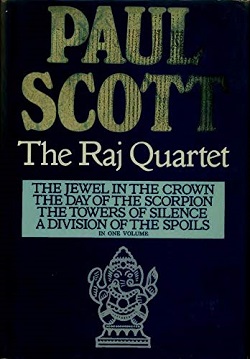
The INA (15th October below) features in the fiction of Paul Scott but not in that of Simon Raven. Simon Raven (1927- 2001) is an author now lesser known than his contemporary, Anthony Powell. He too wrote a sequence of ten novels, “Alms for Oblivion”, over the years 1964-76. They differ from Powell in several ways. They are scabrous and racy, the characters have more life to them, with a preference for sexual fetish. Raven's cast comes from the peaks of the establishment, its members variously pompous or cynical, many natural cheats motivated solely by self-advancement. The plots include Suez, Cyprus, and a Cambridge college under assault by the 1960s. The seventh to be written “Sound the Retreat” of 1971 is set in the period of Britain's wavering hold over its jewel of empire in the years 1945-46. A group of young officer trainees are put under the command of a Moslem officer, Gilzai Khan. As India fragments on religious lines Khan becomes an object of disfavour in Delhi for his resistance to partition. Raven's tone is raucous comedy, closer to Waugh than Powell, with added sex. An obituary declared that “he combined elements of Flashman, Waugh's Captain Grimes and the Earl of Rochester.” He put Lord Annan, his tutor at Cambridge tutor, in mind of the young Guy Burgess. The strength of “Sound the Retreat” is that it captures a part of the British experience in India; but “A Passage to India” it is not. Most conscripts loathed India. They detested the heat, the food and the diarrhoea that never ceased. They disliked the inhabitants almost as much as the old India hands and officers who commanded them. The novel is set after the election of 1945. Churchill won the home vote with ease. It was the postal vote from the conscripts across the world that sank him, the motivation to hit back at the officers. Much of this distemper is caught by Raven. The army is out of its depth in a situation of civil and religious disorder. The officers, blinded by protocol, are both inadequate and devious. Disease carries off one of the young officers. The main female character, Margaret Rose Engineer, is mixed-race and terrified that she will have no place in the independent country-to-be. The racial abuse is rife and abashed, to the extent that it feels as if the author may well be sharing it. A strain of misogyny runs through the novels which grates. Nonetheless “Alms for Oblivion” is a set of novels that is like no other in the same way as is the ten-novel “Strangers and Brothers” sequence of C P Snow. Whereas Snow is the disadvantaged boy who did good Raven is the boy of privilege gone to the bad. The ninth novel “Bring Forth the Body” ends on a cruel moral note. Reading Raven induces a guilty sense that we should not approve at all. Paul Scott is a weightier writer by any standard but he cannot match Raven for sheer dash and fun. The princely states are central in the fiction of Paul Scott. In “A Division of the Spoils”, the last of his Raj Quartet, a newspaper is cited with news that a prince is consulting lawyers in Switzerland with a view to suing the government of Britain. His case is that he has a treaty with a sovereign government that cannot be abrogated by one side. Scott's novel is six hundred pages long. That means that it occupies more space, intellectual and thematic, than a television programme can manage. It is a reminder as to why we have fiction at all. It is documentary's complement that renders the world in a greater richness. Paul Scott lived from 1920 to 1978. He was posted as an officer cadet to India. He became a captain in the Indian Army Service Corps and was involved in the retaking of Burma from the Japanese. India left him with amoebic dysentery which was undiagnosed and was implicated in his resort to alcohol in excess. His last quartet of novels was initiated by a visit to India in 1964. “The Jewel in the Crown” was published in 1966, “The Day of the Scorpion” in 1968, “The Towers of Silence” in 1971 and “A Division of the Spoils” in 1974. The last book in the quartet has an immediate first strength. The characters are plunged into a time of challenge and deteriorating order. Historically, the interval between VJ Day and independence was short but every past was once a lived-in present. Scott's quiet observer character Guy Perron looks at the troops who are in his barracks. They are aware that a Germany in ruins is an infinitely better place to be. Perron sees the face of a nineteen year old. “The faces were those of urban Londoners and belonged to streets of terraced houses that ended in one-man shops: newsagent-tobacconist, fish and chip shop, family grocer and a pub at the corner.” “What” wonders author-character “could such a face know of India?” The war has been an accelerating agent to change. The officers club in Mirat looks unchanged with its colonnade a white that dazzles, hung with sprays of red and purple bougainvillea. With the commissioning of Indian officers they are according to the rules permitted to join the club. The old hands respond by emptying chamber pots and excreting in the swimming pool. It is never used again by the Indians who are defending the empire. At the other end of the spectrum of loyalty Scott's policeman-sadist Ronald Merrick is charged with investigating prisoners who have served with the Indian National Army. The charge “waging war against the King-Emperor” is incontrovertible. One of the prisoners has been in Europe. About to be shot by the Free French he has been rescued by Americans to be transported to a cell in India. Meanwhile high politics swirl above the heads of the junior Britons. Pethick-Lawrence from the new Labour government is far away in negotiation with the Congress leaders. The fate of Scott's fictional princely state is in the balance, the crown's representative the political agent an “unemotional man with rigid views.” On the ground far from Delhi the new generation of young is joining the Hindu Mahasabha and Rashtriya Swayam Sevak Sangh, radical groups equally hostile to British and Congress. Against them are the Muslims with their views of the new government-in-waiting. “Congress is a Hindu party whatever they pretend” says a son to his father who is hoping for accommodation: “They will exploit us as badly as the British, probably worse...A Hindu raj would be a catastrophe. They hate us.” Scott's book climaxes in a brilliantly described set piece, a murderous assault on a train packed with passengers seeking to flee the inter-communal strife. Scott's writing is rich in detail and low in symbolism. In that he is the reverse of another Paul. In “Kowloon Tong” of 1997 Paul Theroux wrote a novel of Britain's exit from Hong Kong. It is thinly textured in comparison with Scott. Scott's martinet villain Merrick meets a grisly end. Sarah Layton goes to revisit an old haunt, a piece of India made to masquerade as India. But she sees it differently: “the name, Rose Cottage, given it by a previous owner, a tea-planter, was now all too clearly, absurdly, inappropriate.” There is the difference between the documentaries of television and the long dense making of fiction. The first shows well how it looked, but the latter conveys how it felt. |
Reviewed by: Adam Somerset |
This review has been read 601 times There are 41 other reviews of productions with this title in our database:
|
