| The Artistic Personality Uncovered |
Art & the Senses: Body & Mind |
| Frank Barron, Susan Magsamen & Ivy Ross , Psychology and Neuroscience , May 21, 2026 |
 The brain was first scanned in 1990. By 2010 the machines were ubiquitous in research centres. Music is the most researched, thousands of papers now on the subject. The seven benefits of music feature below 13th April.
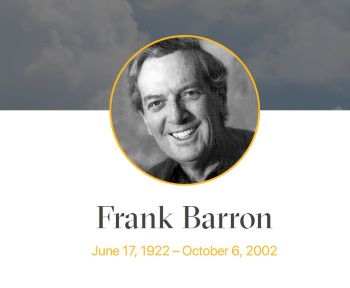
 The knowledge that music impacted the spirit goes back millennia. Song and dance are inseparable in many languages. They were deployed for ailments and at the time of death's imminence. The oldest written account is biblical; David plays the lyre to lift Saul from depression. Martin Luther held that music was a divine power that creates order, specifically made to combat the destructive power of evil. The basis of neuro-aesthetics is clear. Aesthetic experiences are an emergent property of interactions. These occur across a triad of neural systems that involve sensory-motor, emotion-valuation, and meaning-knowledge circuitry. The last is important. Human beings are meaning-seeking organisms. It is both the almond and the seahorse. Together. * * * * Is there is an identifiable aesthetic personality? Susan Magsamen and Ivy Ross are authors of “Your Brain On Art”. Their first page reports from the Max Planck Institute for Empirical Aesthetics in Frankfurt. Its research has worked on the features of the aesthetic mindset. These are a high level of curiosity, a love of playful, open-ended exploration, keen sensory awareness, and a drive to engage in creative activities as a maker and/or beholder. Frank Barron (1922-2002) does not feature in the book. He was the scholar who pioneered research into the psychology of creativity. He noted in 1965 that creative individuals had distinguishing characteristics. “The thing that was important was something that might be called a cosmological commitment”. “It was a powerful motive to create meaning and to leave a testament of the meaning which that individual found in the world, and in himself in relation to the world”. Creative people have a high level of intuition. “So our finding was that intuition, linked with some degree of introversion, was related to creativity”. Creative people have a preference for complexity. “Creative subjects, sought to find a way to take something quite complex and, in it, find a simple order. “This is something like the definition of elegance in mathematical explanation. And the same, I think, probably applies to a work of art. So that frequently the final product or explanation is amazingly simple but is based on an extremely complex substrate of empirical or individual observations” In 1958 “Their universe is thus more complex, and in addition, they usually lead more complex lives, seeking tension in the interest of the pleasure they obtain upon its discharge” “Creative people like things messy, disordered, ambiguous, and asymmetric but they also have a strong motivation to bring order and definition to the world.” “Barron argued that creative people used the holistic approach to antinomies, polarities, or oppositions. Creative individuals were able to entertain many opposites in psychic life simultaneously. “They may be at once naive and knowledgeable, being at home equally with primitive symbolism and rigorous logic, maybe highly disciplined, yet quite free, at once masculine and feminine. “The creative person is both more primitive and more cultivated, more destructive, a lot madder and a lot saner, than the average person”. In 1953 Barron developed The Barron Ego-strength Scale which indicated positive aspects of functioning and psychological well-being. He argued that creative people appeared highly neurotic on personality tests but also showed high levels of ego-strength that allowed them to rally from setbacks and hardship. Creative individuals also have independence of judgement, the ability to go against the mainstream. “The creative subjects maintained their independence and expressed the correct opinion, rejecting the consensus”; “a willingness to take risks; “adventurousness and courage to commit themselves.” * * * * The two authors of “Your Brain On Art” have backgrounds to impress. Susan Magsamen is executive director of the International Arts + Mind Lab at the Brain Science Institute, Johns Hopkins School of Medicine. Ivy Ross is Chief Design Officer for Consumer Devices at Google and a jewellery designer. She features in a compilation of the hundred most creative people in business. “Your Brain in Art” comes with 13 pages of notes and references to 224 sources and journal references. To read it, however, is to read two books. The prose in the book itself is not composed in an academic style but more akin to the jaunty and informal style of the self-help publishing genre. So a reader who wishes to know more can, for instance, follow a line of research on the use of hands. A 2018 reference that links knitting, pottery and painting is given. But the reader of the text itself frequently runs across colloquialisms which jar. T S Eliot is introduced for his critical work on Dante. “Eliot was on to something” we are told. “Scientific evidence shows that taking part in artistic and cultural activities can improve our health,” That is accepted. “There are clear medical benefits in a number of conditions.” So there is a discordance between the experience, and the working lives, of the authors and the prose that is attributed to them. The blurb on the cover sets the tone. “The arts bring joy. Inspiration. Wellbeing. Understanding.” Fair enough. Plus “even salvation.” Salvation? The chattiness of the style pervades. “You couldn't talk to Ed for more than five minutes without getting hooked by his insatiable wonder and curiosity.” Ed is Edward O Wilson. And the instrumental aspect. “We're on the verge of a cultural shift in which the arts can deliver potent, accessible and proven solutions for the wellbeing of everyone.” This is semantic syrup. Amidst the content are features that are not in accord with the science and discipline of neuro-aesthetics. An advocate for a therapy “Meta-Music Healing” says: “Every cell of our body vibrates to its own frequency and interplays with other cells. Sometimes we get into these beautiful places of harmony where all of our components co-exist, and other times, some of them go out of “tune”. A somatic therapist states that “black and indigenous people don't experience post-traumatic stress disorder.” A mixed-media artist says “we believe that immersive and multisensory spatial experiences, when combined with meaningful and cutting-edge data visualisation techniques, can create a healing power.” When it turns to history there is a blurry imprecision “The arts have spurred societal shifts: The Renaissance propelled humanity out of the Middle Ages with evocative music and visual storytelling.” In fact the precise genesis of the Renissance continues to be a source of lively debate among historians. It was as much to do with the word, Petrarch's interest in the studia humanitatis inspired by Cicero, Quintillian and Aulus Gellius. Happily there are good things in the book to be discovered. These will feature in the next article. |
Reviewed by: Adam Somerset |
This review has been read 212 times There are 16 other reviews of productions with this title in our database:
|
