| Society, Psychology, Art's Purpose |
Art & the Senses: Body & Mind |
| Ellen Winner- How Art Works , Oxford University Press , May 11, 2026 |
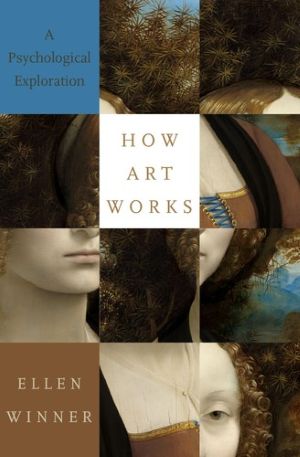 The first part looked at art and psychology at the experimental and observational level.
Turning to the larger scale the book looks at the relation of art and its society. “Art is a socially constructed concept created by culture. Because it is socially constructed, it is not mind-independent. It is our minds that pull together into one category we call art. “ “Moreover art is a socially constructed concept with very blurry boundaries. And what counts as art can change over time and over culture.” This is an important observation. If a culture removes criticism, which is a honed expression of the social mind at work- a first word albeit never a last- then artistic activity that fails to be meaningful art is inevitable. Winner refers by analogy to Wittgenstein's well-known example about the nature of games. Solitaire, bridge, chess, Olympic contests, Minecraft are not bounded by one set of features. Hence Wittgenstein's recourse to “family resemblances.” And there is, says Winner, no one “best” example of a game. “Nor is there anything to verify whether something is a game. To eat insects for a television competition, to dare traffic lights, to run in front of a robotic car are games for some, but not universally agreed by all. Winner cites the philosopher Morris Waltz that art is an open concept. “Its boundaries are infinitely expandable because it must encompass previously undreamed of forms. We cannot list the defining features of art because this would close the concept of art.” * * * * Winner refers to Denis Dutton, philosopher of aesthetics, who did list the features of art, at least a group of characteristics that may, although not exclusively and not by necessity, be possessed by artwork. These are: Representation Expressive individuality Emotional saturation Direct pleasure Intellectual challenge Imaginative experience Culture of criticism Style Focus Existing within art traditions and institutions To which Winner adds her qualifications. Skill and virtuosity. “An art work is made with skill. This connects to pleasure: we admire skill, and recognising great skill is pleasurable.” Expressive individuality. “Artworks express something about the artist who made them, and we enjoy thinking about the mind behind the works.” Emotional saturation. “Artworks are emotional, as is the experience of perceiving these works. The representational content of a work provokes emotions in us, such as sorrow at a sad scene in a painting. Direct pleasure. “Art causes immediate pleasure for its own sake, with no utilitarian value.” Intellectual challenge. “Artworks challenge us intellectually, and this too is pleasurable. The philosopher Alva Noe echoes this view when he writes that art aims to disclose us to ourselves, and expose to us what we did not know about ourselves. He calls art “a strange tool.” Imaginative experience. “Artworks create imaginative experiences for both the maker and the perceiver and Dutton thinks this is perhaps the most important of his twelve features, and so do I.” Culture of criticism: “A critical language exists alongside artworks; critics talk about art, as do audiences. Necessary?...Any human activity that is complex is accompanied by criticism, whether science, politics or athletics.” Style. “Artworks are made in particular styles, and hence abide loosely by sets of rules, like most human activities- language use, norms of politeness, nonverbal communication, cooking.” Existing within art traditions and institutions. “Artworks are typically set apart from ordinary life, whether by a stage, a frame, a concert hall or a museum. This sounds like what Schopenhauer meant when he wrote that “art plucks the object of its contemplation from the world's course, and holds it isolated before it.” * * * * Winner recalls Jose Ortega y Gasset: “The artistic object is artistic only to the extent it is not real. In order to enjoy Titian's portrait of Charles V, it is a necessary condition that we do not see the authentic, living Charles V but only a portrait of him, that is, an unreal image.” “All forms of art- whether visual art, music, literature or dance- invite us to enter into an imaginary space, taking us away from “non-art reality.” Much of the work in neuro-aesthetics- see below “Art Cure” by Daisy Fancourt- focuses on the visual arts. Ellen Winner cites the philosopher Roger Scruton who looks at a carpenter at work. The exact way to frame a door, he says, is an aesthetic judgement and not an instrumental act. “We care about the way things look,” says Winner, “when we set a table for guests, when we arrange our living room furniture, when we pick our clothes.” “This aesthetics of everyday life”, argues Scruton, “is a state of mind that is fundamental to human nature, and lacking in other animals.” “Thus works of art are things that function in certain ways: they are things that are to be enjoyed for their appearance and whose appearance is to be interpreted purely for what it means to be and without reference to some further practical function.” “This seems to me to close to the idea of repleteness. And also close to Kant's belief that the aesthetic attitude is one of disinterested pleasure, divorced from practical constraints, divorced from any desire for the object causing the pleasure.” |
Reviewed by: Adam Somerset |
This review has been read 101 times There are 12 other reviews of productions with this title in our database:
|
