| Classy First Reprise for Playful Coward/Lean Tribute |
At the Torch |
| Torch Theatre- Brief Encounter , Torch Theatre , October 13, 2015 |
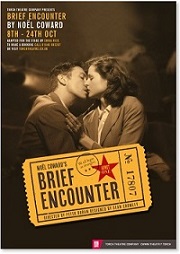 For the second time this autumn Noel Coward’s uneasy lovers- shopping and cinema-going Laura Jesson and GP one-day-a-week hospital doctor Alec Harvey- walk a Welsh stage. Whereas Swansea’s Lighthouse performed the 1936 original, comprising just five scenes, Peter Doran’s choice for the large Torch production is Noel Coward via David Lean and then recreated for theatre eight years ago by Emma Rice and Cornwall’s Kneehigh Theatre.
 The Torch is the first company to reprise Kneehigh’s treatment. It is a distinctive choice for the season with one more than appropriate reason. The programme omits mention that much of the scenario plays out in the station café of a railway junction town Milford. Less a place with a commanding view of a great natural harbour its county is unspecified but it is very Home Counties, a place for ladies called Dolly to return from Town, weighed down by a surfeit of shopping. This production is not a pure replica of the Kneehigh version, which had a toy train or two, but its mix of Coward drama, period song, physical theatre, cinema mimicry and theatre convention-breaking makes for a concoction that has its Friday night audience delighted. Coward’s original tale is one of slenderness. The layers of addition are not quite able to give it that sense of theatrical propulsion to take it to two hours. If that is a small structural quibble Peter Doran and company have given it a class treatment, which begins even before the theatre auditorium doors have been opened. The Torch’s foyer is decorated with cinema memorabilia and staff and helpers are in period dress. In the main house itself ushers with torches are on hand, in uniforms with two lines of gold buttons, all topped with little round caps with red and gold encircling braid. Any audience uncertainty over the identity of these ushers is dispelled when one breaks into song. “A Nightingale Sang in Berkeley Square” is sung with a great sweetness. Two late arrivals in hat and billow of a coat take front-row seats to whispers of “shush” from the faux-ushers. Meanwhile husband Fred, a uncharacteristically subdued Liam Tobin, sits in a plain armchair on a stage-wide screen. Peter Doran and video designer Lloyd Grayson execute a surprise, enough to cause an intake of breath. Laura Penneycard’s Laura joins her husband; it’s “Purple Rose of Cairo” turned around and it is very good. The cast of nine pick up musical instruments effortlessly. Oliver Wood is perky Stanley, with his tray of buns and fruit, and his eye for Katherine Toy’s Beryl. Liam Tobin is also black-suited Albert Godby, the presiding station master, with his own flirting eye on café manager Charlotte Workman’s Myrtle. These lightly connecting salt-of-the-earth couples are the dramatic counterpoint to Laura and Matt Wilman’s terribly serious Alec. Tonally the treatment plays on the fact of it all being so far away. The climate of moral restraint and social condemnation, to be part-slackened by the Second World War, now renders the nineteen-thirties utterly remote. The first act plays with parody. The lovers-yet-to-be are served by a very peculiar waitress. Coward back in the thirties did not have his doctor enjoy a quip about having killed two patients that morning. The scenario does away with the pneumoconiosis exchange that today has a ring of halting self-consciousness. But then the second act seems to want to admit that, for all the quaintness of the exchanges, these emotions are deep and authentic. The songs are chosen to make comment, with some irony, on the action. “Mad about the Boy” sings Liam Tobin. James Williams is musical director and creates textures of delicacy and variety. Cafe chansons are led by an accordion. A last song combines four male voices in harmony but there are also exuberant moments of vaulting falsetto. In full homage to David Lean “Brief Encounter” closes to the dramatic soaring piano chords of Rachmaninoff. “Brief Encounter” enjoys its moments of metatheatre. “Oh, shut up” says Beryl to the musicians playing the same few notes over and over. In truth back in 2007 it was not clear to me what Kneehigh was trying to say, not that was any hindrance to the company having its greatest success. But that in turn was the path to its least successful show. But there is all the difference between David Lean’s almost antique Britain and Jacques Demy’s Cherbourg, which at fifty years of age is still entrancing and youthful. If all that Rachmaninoff seems overdone to a modern viewer the best thing in the film now are the night and shadow created by Robert Krasker in his photography. “Brief Encounter” is also a reminder as to how central a role in culture was played by the old railway of iron and soot. It is there in the hugely popular Eric Ravilious and his equal, Claughton Pellew. The rail journey is a perennial over decades in Hitchcock and a climax in the drama, in Britain, of “the Ladykillers” and “It Always Rains on Sunday”. It is all so different from the sleek Pullman cars from across the Atlantic to be seen in Fred Astaire or “Double Indemnity.” Sean Crowley’s design economically makes a café counter out of a piano but also locates “Brief Encounter” in its context with a metal bridge that spans the tracks and overlooks the playfulness and the passion that carry on beneath. This is a big production done with relish and manifestly loved by its first night audience. |
Reviewed by: Adam Somerset |
This review has been read 3174 times There are 81 other reviews of productions with this title in our database:
|
