| Culmination of a Remarkable Journey |
Arad Goch |
| To Kill a Machine- Scriptography & Arad Goch , King's Head Islington , April 24, 2016 |
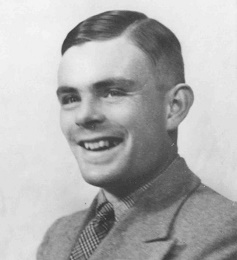 Each era gets the theatre that feeds its concerns. When Ian McEwan wrote a script for television called “the Imitation Game” the year was 1980 and the theme was gender discrimination. The life of Alan Turing has been dramatised before for stage. Thirty years ago the revelation of Ultra was still relatively recent and it was a world before AZT therapy. In 1986 “Breaking the Code” was written with Derek Jacobi in mind to play Turing. Hugh Whitemore's play was a success first in London, then on Broadway, before eventually making it to film. Catrin Flur Huws' play is very different from the traditional realist mode of a Hugh Whitemore script.
 The hour long production is elliptical in form. The trajectory goes from Turing the sports-averse schoolboy to his end. Robert Harper, Rick Yale and Francois Pandolfo swap various roles. Pandolfo in adulthood plays the role of colleague Gordon. The script skips further explication that it is Gordon Welchman, himself to lose his security clearance, like Turing, but with less lethal consequence. The concept of the imitation game is described with economy. Metaphor is an element that is both crucial but elusively difficult for a writer for the stage. Catrin Fflur Huws' writing ripples with suggestiveness that meshes seamlessly with Cordelia Ashwell's design. Glass spheres overhang the players like an intimation of the Ptolemaic heavens. The deadly apple has its literary echo in the tale of Snow White. Turing is a presence whose importance in his own time was colossal and unrewarded and whose shadow over history grows ever greater. The author herself is a lawyer. Law is an undertaking that seeks to generate codes of universal application. But law is like the Goedel formulation that absorbed the young Turing. It can never be both complete and consistent, hence the importance of case interpretation. Law like the universe is not Newtonian. AI has been in the news this season on counts of both triumph and shame. On the one hand its success in the game of Go is a leap beyond the pure algorithm-following procedural method for chess. On the other hand a Microsoft chatbot descended rapidly to become a foul-mouthed misogynist. “To Kill a Machine” circles around the central question of consciousness, whether it can be truly achieved extra-somatically. Intelligence is not just adherence to an ever greater complex of rules. Of his fellow defendant in Manchester Turing says “I know the rules. He lied.” To be truly intelligent the machine must know how to lie. That in turn necessitates taking the role of the other, which is the work of observation that can only for the present be made from being in a body. Most of all thought, the working-through of intelligence, is inseparable from feeling. When Turing starts his judicially ordained treatment he says that that the consequence is that he can no longer think. “To Kill a Machine” is complex and meditative, far distant from Whitemore of a generation back. But then theatre feeds current concerns. Gwydion Rhys has been praised over the run of the production. He has appeared on this site before from pantomime at the no-longer Muni to “the Village Social.” As Turing he assumes a squeaky prissy voice with hand movements of great eloquence. “To Kill a Machine” is the role that marks the transition from young actor to early maturity. He is now among the very best of his generation of actors of Wales. The journey of “To Kill a Machine” has been remarkable. It was first to be glimpsed as a fragment, and admittedly of some strangeness, some time ago in Aberystwyth's valuable and versatile studio. Journeying to Edinburgh and London has brought it a big and new audience. The King's Head is a venue of lustre but tiny in size with the audience on three sides. On its second Saturday in Islington a face familiar from the big screen was a few feet distant from Gwydion Rhys and company. That actor's engagement and response to Scriptography's production was manifest, with all the attention and intelligence that he gives to his playing of the young Charles Xavier. |
Reviewed by: Adam Somerset |
This review has been read 1644 times There are 21 other reviews of productions with this title in our database:
|
